
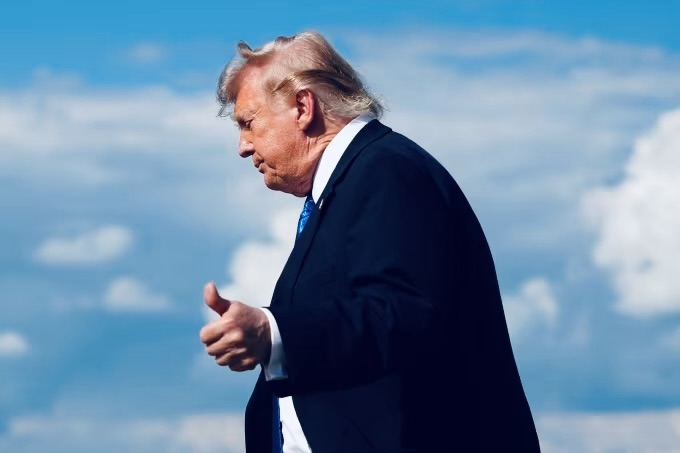
President Donald Trump has once again sparked discussion online after sharing a graphic that ranks U.S. presidents — with Trump himself placed at the very top as the “greatest” president in American history.
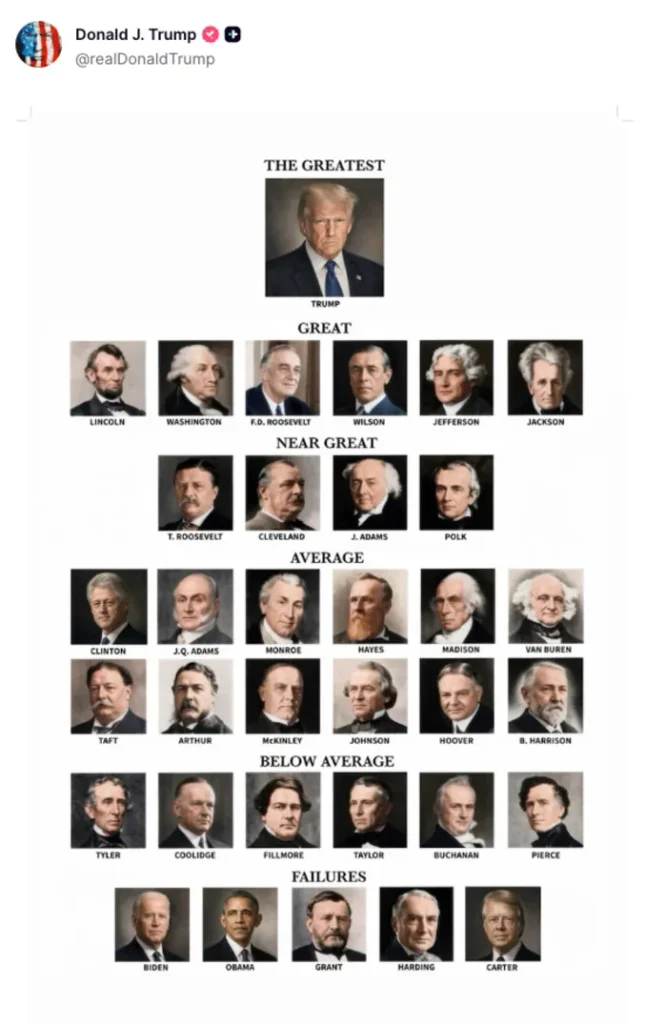
The ranking places Trump above figures such as George Washington, Abraham Lincoln and Thomas Jefferson, a decision that has naturally attracted plenty of criticism. What makes the list even more controversial, however, is not simply Trump’s position at the top, but the way several other presidents are ranked — and the presidents who are missing altogether.
It is unclear who originally created the ranking or what criteria were used. But looking closely at the list reveals several inconsistencies that are difficult to ignore.
Some unexpected choices among the “great” presidents
The graphic places Franklin D. Roosevelt, Woodrow Wilson and Andrew Jackson in the “great” category alongside Washington, Lincoln and Jefferson.
That is likely to raise eyebrows among many conservatives.
Roosevelt is closely associated with the New Deal, which dramatically expanded the role of the federal government during the Great Depression. Wilson also oversaw a major expansion of federal power and supported policies that remain unpopular among many conservatives.
Andrew Jackson presents another complicated case. His presidency remains deeply controversial because of his treatment of Native Americans and his ownership of slaves.
Interestingly, Trump later shared another version of the ranking in which Wilson was moved out of the “great” category and placed among presidents described as having “broken” America.
Why is Calvin Coolidge ranked so low?
Another questionable choice is Calvin Coolidge, who appears in the “below average” category.
For many conservatives, Coolidge is regarded very differently. He is often remembered for his limited-government philosophy, lower taxes and opposition to government expansion.
Some on the political right even view Coolidge as an important figure in the development of modern American conservatism.
That makes his relatively low position on Trump’s list particularly surprising.
Andrew Johnson is rated “average”
The ranking also places Andrew Johnson in the “average” category.
That is difficult to reconcile with the way historians have generally evaluated his presidency. Johnson, who became president after Lincoln’s assassination, is widely criticized for his handling of Reconstruction following the Civil War.
He was also the first U.S. president to be impeached.
In the Siena Research Institute’s surveys of presidential scholars, Johnson has repeatedly ranked among the very worst presidents in American history.
So his placement in the middle of the list raises another obvious question: What criteria were used to determine these rankings?
Trump’s changing view of William McKinley
William McKinley is another interesting example.
Trump spent considerable time praising McKinley during 2025, particularly because of McKinley’s use of tariffs. Trump presented him as an example of a president who understood how tariffs could benefit the United States.
Trump even restored McKinley’s name to the Alaskan mountain now officially known as Denali, arguing that McKinley had been an important and underrated president.
Yet in this ranking, McKinley is placed only in the “average” category.
That apparent change in assessment makes the list even harder to interpret.
Ulysses S. Grant labeled a “failure”
Perhaps one of the more surprising rankings is Ulysses S. Grant being placed in the “failure” category.
Grant is certainly not generally regarded as one of America’s most successful presidents. His administration was damaged by corruption scandals, and his political leadership has been debated by historians for generations.
However, describing his presidency simply as a failure ignores some of its important achievements, particularly Grant’s efforts to protect the civil rights of African Americans during Reconstruction.
Even prominent Republicans have defended Grant’s historical reputation. Senator Tom Cotton, for example, has previously described Grant as one of the greatest civil-rights presidents in American history.
The biggest mystery: Who is missing?
Perhaps the strangest part of the graphic is not who appears on it, but who doesn’t.
Several major presidents are completely absent, including Ronald Reagan, Dwight Eisenhower, John F. Kennedy, Lyndon B. Johnson, Harry Truman, Richard Nixon, Gerald Ford, George H.W. Bush and George W. Bush.
That makes the ranking difficult to take seriously as a complete assessment of American presidents.
The graphic also appears to be based largely on an older presidential ranking published by Life magazine in 1948. The modern version seems to have been modified by adding Trump to the top category, Bill Clinton to “average,” and Joe Biden, Barack Obama and Jimmy Carter to the “failures” category.
But if some modern presidents were added, why were others left out?
That is especially notable because presidents such as Reagan and George W. Bush would almost certainly be of particular interest to Trump’s conservative supporters.
A political statement rather than an objective ranking?
Ultimately, the biggest problem with the graphic may be that there is no clear explanation of how the rankings were determined.
Presidential rankings are always subjective. Historians can disagree strongly about the same president, depending on whether they prioritize the economy, foreign policy, civil rights, government spending, military decisions or the long-term impact of a presidency.
But a credible ranking normally explains its methodology.
Trump’s graphic does not.
Instead, it places Trump above Washington and Lincoln while putting several historically important presidents in categories that contradict how many scholars and historians have traditionally evaluated them.
For that reason, the list may say more about Trump’s own view of his presidency — and his political preferences — than it does about the actual historical standing of America’s presidents.